Showing posts with label Hypertension. Show all posts
Showing posts with label Hypertension. Show all posts
Sunday, October 1, 2017

Saturday, May 28, 2016
How much low Salt in Diet might be Safe
General advice to
patients suffering from hypertension is to consume low salt diet.
But, how much less is safe for the patient has not been clearly
defined. Generally, it is advised to remain below 2.3 gms/day. Some
say 1.5 gms/day.


A large worldwide
study has found that, contrary to popular thought, low-salt diets may
not be beneficial and may actually increase the risk of
cardiovascular disease (CVD) and death compared to average salt
consumption. The study suggests that the only people who need to
worry about reducing sodium in their diet are those with hypertension
(high blood pressure) and have high salt consumption.
The study, involving
more than 130,000 people from 49 countries, was led by investigators
of the Population Health Research Institute (PHRI) of McMaster
University and Hamilton Health Sciences.
Current intake of sodium in Canada is typically between 3.5 and 4
grams per day. Some guidelines suggest to consume salt below 2.3
grams per day, a level that fewer than five per cent of Canadians and
people around the world consume.Only about 10 per cent of the population in the global study had both hypertension and high sodium consumption (greater than 6 grams per day).
Low sodium intake reduces blood pressure modestly, compared to average intake, but low sodium intake also has other effects, including adverse elevations of certain hormones which may outweigh any benefits.
This new study shows that the risks associated with low-sodium intake -- less than three grams per day -- are consistent regardless of a patient's hypertension status.
"An approach that recommends salt in moderation, particularly focused on those with hypertension and high salt intake, appears more in-line with current evidence."
The study was funded from more than 50 sources, including the PHRI, the Heart and Stroke Foundation of Canada and the Canadian Institutes of Health Research.
The article was published in the ScienceDaily, can be accessed here.
Saturday, September 26, 2015
Dosing Blood Pressure Control Medicines at Bed Time Reduces the risk of Stroke and T2 Diabetes Mellitus
We all prescribe medications for control of Hypertension.
Most common among those are the ACE (Angiotensin Converting Enzyme) inhibitors,
ARBs (Angiotensin Receptor Blocker) and Third generation β-Blocker like Nebivolol.
But, seldom we advise the patients which is the preferred time to take these
groups of medications. Most of the patients, conventionally, take these
medicines after awakening, in the morning.
It has been observed that most susceptible people get heart
attack towards dawn or early morning. One of the factors can possibly be due to the
fact that blood pressure starts rising from 03 to 04 AM and gradually rises till 12
Noon.
Normally, there is a fall of systolic blood pressure more
than 10% of mean day time BP reaching the zenith from 12 Mid-Night to 03-04 AM,
regulated by circadian rhythm. This phenomenon is called as “Dipping.”
Alterations in these intrinsic circadian rhythms can result
in the absence
of the nocturnal BP decline (non-dipping). This altered pattern is commonly
seen in patients with essential hypertension, several forms of secondary
hypertension and disorders of the autonomic nervous system.
The clinical relevance of this phenomenon lies in the fact
that non-dipping has been associated with increased frequency of hypertensive
target organ damage (brain, heart and kidney), as well as cerebrovascular and
cardiovascular events in hypertensive patients.
Circadian rhythms
typically originate in “master oscillators” located in the suprachiasmatic
nuclei (SCN) of the anterior hypothalamus. How this hypothalamic rhythm is
translated into changes in blood pressure is not entirely known, but the
autonomic nervous system is suspected to play a role; sympathetic activity is
also modulated by hypothalamic centers, and follows a circadian pattern similar
to that of blood pressure.
Patients are categorized, usually based on
systolic blood pressure, as extreme dippers (night–day blood pressure ratio ≤
0.8), dippers (0.8 < ratio ≤ 0.9), non-dippers (0.9 < ratio ≤ 1.0) and
reverse dippers or risers (ratio > 1.0). Reverse dipper are particularly in
the risk of developing end organ damages.
A new research
article published in The Diabetologia by Ramón C. Hermida, Diana
E. Ayala, Artemio Mojón and José R. Fernández of University of Vigo, Campus
Universitario, Vigo, Pontevedra 36310, Spain, titled as”Bedtime
ingestion of hypertension medications reduces the risk of new-onset type 2
diabetes: a randomised controlled trial” has concluded that in hypertensive
patients without diabetes, ingestion of ≥1 BP-lowering medications at bedtime, mainly
those modulating or blocking the effects of angiotensin-II, compared with
ingestion of all such medications upon awakening, results in improved
ambulatory BP (ABP) control (significant further decrease of asleep BP) and
reduced risk of new-onset diabetes.
 |
| Renin angiotensin pathway or RAAS. (Photo credit: Wikipedia) |
Drugs that target angiotensin include angiotensin receptor
blockers (ARBs), ACE inhibitors and beta blockers. These medications act
through blockade of the RAAS (Rennin-Angiotensin-Aldosterone
System) in kidney that causes blood vessels to constrict and blood
pressure to rise.
Angiotensin, Aldosterone and
adrenaline also contribute to increased glucose (sugar) release from the liver
and decreased insulin sensitivity. These factors can lead to Type 2 diabetes.
The researchers conducted a prospective, randomised, open-label,
blinded endpoint trial of 2,012 hypertensive patients without diabetes, 976 men
and 1,036 women, 52.7±13.6 years of age. Patients were randomised, using a
computer-generated allocation table, to ingest all their prescribed
hypertension medications upon awakening or the entire daily dose of ≥1 of them at bedtime.
During a median follow-up of 5.9
years, 171 participants developed type 2 diabetes. Patients in the bedtime,
compared with the morning-treatment group, showed a significantly lower asleep
mean BP and a greater sleep-time relative BP decline.In the bedtime treated group, there was a lower-prevalence of a phenomenon known as 'non-dipping' -- in which patients' night time BP falls by less than 10% compared to daytime BP. Non-dipping occurred in 32% of bedtime-treated patients and 52% of those getting their treatment in the morning.
There was also a 57% decrease in the risk of developing new-onset type 2 diabetes in the bedtime-treated group after adjustment for the potential confounders of fasting glucose, waist circumference, mean asleep systolic BP, dipping classification and chronic kidney disease.
Specifically, the odds of type 2 diabetes dropped 61 percent for people taking angiotensin receptor blockers at bedtime compared to morning. For those on ACE inhibitors at night, the odds went down 69 percent. People on beta blockers reduced their odds of the blood sugar disease by 65 percent when they took their medicine at night, the researchers reported.
All three classes of medication were associated with a reduced risk of type 2 diabetes when taken at bedtime as the effect will be much more on liver/kidney in comparison to the waning effect at night when taken in the morning.
Let us remember to advise our hypertensive patients to take their anti-hypertensive medications at bed time, especially ARBs, ACE-Inhibitors and Nebovolol for better effect and delaying development of T2DM.
Saturday, April 13, 2013
Apples may be more Susceptible to Kidney Disease than the Pears
Apple or pear?
The body shape determines predisposition to certain disease. When the belly is protuberant and a lot of fat deposit is around the waist line, it resembles the shape of apple; called as "android" type or "central obesity.
In contrast to the apple shape, if fat accumulates around the hip, it is called as "gynecoid" or "gluteofemoral fat"; and resembles the shape of a pear.


In general, though the obesity as a whole responsible for predisposition to certain diseases like diabetes and hypertension; it has been seen that apples are more prone to these diseases than the pears.
It has been seen that the type of fat in gynecoid is more of brown fat deposit, whereas that of android type is more of white fat deposit. Brown fat metabolises fast and gives energy but not the white fat.
The waist-to hip ratio (WHR) measure is a more accurate way to determine body fat distribution. It is determined by measuring the waist size divided by the hip size. Women whose WHR is higher than 0.85 are at increased health risk; so are men with a WHR higher than 1.0.
High blood pressure in the kidneys of people with apple-shaped bodies may be responsible for their increased risk of developing kidney disease later in life, according to a study appearing in an upcoming issue of the Journal of the American Society of Nephrology (JASN).
Higher waist-to-hip ratios were associated with lower kidney function, lower kidney blood flow, and higher blood pressure within the kidneys.
They found that apple-shaped persons -- even if totally healthy and with a normal blood pressure -- have an elevated blood pressure in their kidneys. When they are also overweight or obese, this is even worse.
They found that apple-shaped persons -- even if totally healthy and with a normal blood pressure -- have an elevated blood pressure in their kidneys. When they are also overweight or obese, this is even worse.
The findings suggest that these individuals may benefit from treatments that reduce kidney blood pressure. Lifestyle change, physical activity and modification of diet can prevent diabetes and hypertension.


Wednesday, December 15, 2010
Salt Restriction for Control of Hypertension

Somehow hypertensive patients do not accept medical advice of salt restriction to keep control on their blood pressure. Even after a lot of persuasion a few people only could accept this.
Patents of hypertension want a quick relief from their disease with drugs only. The primary advice of salt restriction, lifestyle modification and Yoga etc are not well accepted.
But, the fact is that only these measures can control blood pressure in many mild hypertensive patients. In moderate to severe hypertension, these measures can reduce the quantum of drug required.
Recommended salt intake per day is around 5 grams/day. Hypertensives are advised to take salt less than this. At this recommendation the systolic blood pressure and diastolic blood pressures are expected to decrease about 7 mms of mercury and 4 mms of mercury respectively at the end of a month.
If Yoga and physical exercises are added it is bound to give more result.

Sunday, April 25, 2010
Low Salt in DASH Menu May Help to Stop Hypertension and Other Diseases
 Image via Wikipedia
Low Salt in DASH Menu May Help to Stop Hypertension and Other Diseases
DASH is acronym for "Dietary approach to stop hypertension". This diet menu has been supported by National Institutes of Health and National Heart, Lung, and Blood Institute, US and some other organizations. Results of the research heavily support the dietary approach to control the hypertension; and so also other diseases like diabetes, obesity, cognitive failure and urinary stone disease.


Tuesday, January 12, 2010
Salt Restriction Can Lower Mortality

The first advice to a hypertensive patient is to lower dietary salt intake. There has been a number of publications in support of salt restriction in diet. The below is a published article in Medpagetoday; will be interesting to read.
A New York City-based health organization is proposing that restaurants and packaged food manufacturers lower sodium levels by 25% over five years to greatly reduce preventable health risks. The National Salt Reduction Initiative (NSRI) request would cut the nation's salt intake by 20%, helping prevent a variety of health complications, including hypertension, myocardial infarction, stroke, and ultimately mortality, a statement from the group said. Salt intake is a major contributor to hypertension, which can lead to a MI or stroke and is a leading cause of preventable death, killing more than 800,000 people annually, the government estimates. Many national and international health organizations support the proposal, including the American Heart Association, which added in a release that the group would like to see sodium levels on packaged and prepared foods halved in 10 years.
|


Sunday, November 15, 2009
A Pearl Of Garlic To Protect Heart

Garlic has antioxidant and lipid lowering property which help to lower high blood pressure. Since long it is being used in India. Some ready made capsules containing garlic as an ingredient are available for hypertensive patients. Raw garlic is more beneficial. As a folk remedy garlic boiled in mustard oil is massaged on the foot to alleviate cold. Whether it acts there I do not know, but it feels great to have that massage.
That garlic has health benefits is nothing new. Since at least 1500 BC, healers in China and India have used the odiferous bulb as a blood thinner. Hippocrates, the father of modern medicine, used it to treat cervical cancer. Louis Pasteur reported on garlic's antibacterial and antifungal powers, which inspired Albert Schweitzer to use it against dysentery in Africa. But now, a team of researchers from the Cardiovascular Research Center at the University of Connecticut School of Medicine have learned how freshly crushed garlic -- as opposed to dried or cooked garlic -- protects the heart. The amount of garlic you need to get the heart-healthy benefits is about a clove a day. According to Herbal Therapy & Supplements, a handy guide by herbalists David Winston and Merrily A. Kuhn, RN, PhD, the best way to use garlic is to mince a clove, let it stand 10 to 15 minutes, then mix it with yogurt, applesauce, honey, or some other carrier agent.
|


Friday, August 7, 2009
Reeling Of Head/Cervical Spondylosis
Reeling of head is a distressing condition.In medical terminology it is called Vertigo.Here there is sensation of reeling of head or the surrounding.There are so many causes for it.It may be physiological or pathological. Mainly three systems are involved in it.The ear and related nervous system,the eyes and related nervous system or the peripheral sensory system.
 The Course Of Vertebral Artery.
Physiologically this is seen while suddenly getting up from a sitting or standing position called a positional vertigo.Amongst the pathological conditions atherosclerotic hypertension is most common .Other diseases of the three system described above can give rise to vertigo.Common causes are an infection or disease of the middle ear,visual disturbances like ill fitting glasses , sensory disturbance of lower limbs and more generalized diseases like diabetes are important.
Atherosclerosis causes impairment of blood flow to the brain and it's subsections causing vertigo.Any body presenting with vertigo should be examined for atherosclerosis first.Hypertension easy to diagnose should be treated.Investigations like blood lipid profile is contributory.
Ill fitting glasses easily be corrected and an ear disease is easy to diagnose and treat.
The next important disease to cause vertigo is Cervical Spondylosis.Here the seven neck vertebral bones get affected commonly due to aging process.Other diseases of neck bone like Ankylosing Spondylosis also
 Blood Supply
important.Here the vertebrae are deformed ,loose the flexibility and loose the natural C curve.The deformity may pose an obstruction to the blood flow in the vertebral arteries which travels through the bony processes of of neck bones.The vertebral arteries in tern could not deliver required amount of blood to the brain system and cause relative ischaemia and the consequent symptom of vertigo.This disease can also be diagnosed easily from a host of available investigations i.e. from a good quality digital X-Rays to MRI .
Adequately treated spondylosis can go a long way in relieving the symptoms.
But before jumping to diagnosis of Cervical Spondylosis as cause of vertigo the more common and dangerous cause atherosclerotic hypertension should be excluded.
MRI Image.

 The Course Of Vertebral Artery.
Atherosclerosis causes impairment of blood flow to the brain and it's subsections causing vertigo.Any body presenting with vertigo should be examined for atherosclerosis first.Hypertension easy to diagnose should be treated.Investigations like blood lipid profile is contributory.
Ill fitting glasses easily be corrected and an ear disease is easy to diagnose and treat.
The next important disease to cause vertigo is Cervical Spondylosis.Here the seven neck vertebral bones get affected commonly due to aging process.Other diseases of neck bone like Ankylosing Spondylosis also
 Blood Supply
important.Here the vertebrae are deformed ,loose the flexibility and loose the natural C curve.The deformity may pose an obstruction to the blood flow in the vertebral arteries which travels through the bony processes of of neck bones.The vertebral arteries in tern could not deliver required amount of blood to the brain system and cause relative ischaemia and the consequent symptom of vertigo.This disease can also be diagnosed easily from a host of available investigations i.e. from a good quality digital X-Rays to MRI .
Adequately treated spondylosis can go a long way in relieving the symptoms.
But before jumping to diagnosis of Cervical Spondylosis as cause of vertigo the more common and dangerous cause atherosclerotic hypertension should be excluded.
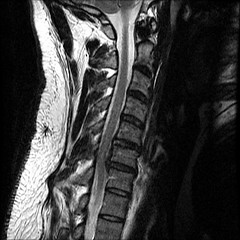
MRI Image.
Monday, June 8, 2009
BLACK OUT AND FALL ON GROUND ???

 Image via Wikipedia
Most common are (a) Simple vasovagal attack (b) Hypertension (c)Heat Stroke (d) Brain Stroke (e) Heart Stroke (f)Absent Attack of Epilepsy and more diverse (G) Fracture of head of thigh bone called Femur.
The vasovagal attack being more simple may occur after listening to very shocking news , seeing a dreaded scene or sudden rising from a sitting posture .Simple measure like elevating the legs will normalize blood flow to the brain and patient gains consciousness.Other injuries are to be looked after.
Hypertensives especially undiagnosed ones and those dincontinued drugs against a medical advice or due to complication called hypertensive encephalopathey may suddenly fall down.They usually complain of reeling of head before the episode.Obviously the root cause is to be treated.Associated injuries in form if a traumatic haematoma of scalp has to be evaluated in the light of possible injury to brain.
Heat stroke is a tell tale diagnosis and has to be treated promptly.Main stray of treatment being rehydration by intravenous fluid administration and cooling.
Juvenile epileptics especially experience absent attacks sustaining multiple injuries ,has to be treated accordingly.And they must be warned and guided not to go to dangers places like fire and water body.
A fracture of head of thigh bone ,femur mainly due to old age osteoporosis usually seen in menopausal lady and person falls on ground.Also pathological fractures due to other causes importantly a metastatic cancer may cause it.A simple X-Rays will clinch diagnosis and guide the treatment.Post menopausal ladies should always get calcium supplement to prevent osteoporosis.
Heart stroke and brain strokes are more dangerous usually associated with hypertension and/or diabetes.So the primary disease if known should be kept under control always and patient should not discontinue drugs without consulting treating doctor.If undiagnosed and these diseases suspected one tablet of aspirin 150 mg. ,if available should be started at home and swiftly shifted to the nearest health centre even if small one.Because first-aid can be started which is similar everywhere.
BESIDES THERE ARE SO MANY OTHER CAUSES OF BLACK OUT AND FALL ON GROUD, ARE OF ACEDEMIC INTEREST AND BY FAR ABOVE ONES TO BE KEPT IN MIND.

Subscribe to:
Posts (Atom)
Featured Post
Cyclodextrin for Treatment of Atherosclerosis
Cardiovascular disease from atherosclerosis is one of the most common causes of death worldwide. Inflammation plays a crucial role in ...

-
A Foley's Catheter I was called at 10.30 PM to attend a case of bleeding from urethra following urethral catheterization in a semi...
-
While giving advice on diet, the dietician/doctor, most of the time, advises to discard the yellow portion of a boiled egg thinking the yel...
-
A novel coronavirus emerged in China in 2019, named as SARS-CoV-2, become a pandemic. Scientists, Researchers and Health c...
