Showing posts with label Urinary system. Show all posts

Saturday, January 29, 2011

Painful Bleeding per Urethra can be due to Urinary Stone

Three-dimensional reconstructed CT scan image ...Image via WikipediaBleeding whether frank or small in amount, accompanied by pain either in urethra or in abdomen are the hallmarks of stone in urinary tract, technically called painful haematuria.
A stone usually forms in the kidney; but may form in urinary bladder. After formation in the kidney it descends down through the urinary tract. Sometimes it is struck en route, anywhere from ureter to urethra. Movement of stone causes pain and bleeding is from the mechanical effect.
According to location of the stone pain may be felt at a particular place in the abdomen. Its severity also depends on the location. A stone in the ureter, the collecting tube of urine causes maximum pain to be followed by a stone in urethra or urinary bladder.In kidney the pain is usually a constant moderate ache.
The very characteristic of pain due to stone in ureter makes the diagnosis easier. It follows a path from loin to groin or urethra; and is very severe; patient does not get comfort in may position; just rolls about.
Not rarely a stone passes out in urine giving relief from pain and bleeding to the patient.
Now-a-days, the diagnosis is very much easy due to advent of ultrasonogram. A plain x-rays may show a radiopaque shadow in the line of urinary system.There are many more investigations available to reach to the diagnosis of the root cause of stone formation and to know the health of urinary system.
Drinking as much of water that can give an urine output of about 1.5 to 2 liters/day is the priceless advice and the simplest way to prevent stone formation. But, seldom people follow this advice.
Enhanced by Zemanta

Thursday, May 13, 2010

Why Urinary Tract Infections in Females are Difficult to Treat

Urinary systemImage via Wikipedia
Urinary tract infection is very common in females due to various reasons. Most of the women suffer from urinary infection at least once in their life time. It is also difficult to eradicate.
The urinary tract extends right from the kidneys to the end of urethra. The urethra in female is only 4 cms in length in comparison to male where it is 20 cms. It is also situated in close proximity to vaginal and anal opening. Vagina and anus are the potentially infected places; harboring different microbes, those can have easy access to urethra. This anatomical disadvantage in female may make them susceptible to frequent urinary tract infections.
Ladies get infection from their sexual partners during active sex life. Masturbation also contributes to the entry of infection by way of inflicting minor injuries. Those help bacteria to colonize and spread infection.
Sometimes catheterization of urethra may be necessary for different medical conditions. Pelvis surgeries in the female viz. hysterectomy and caesarian section may require catheterization of urinary bladder. An unclean catheterization may introduce bacteria to the urinary tract; and urinary bladder in particular gets infected in this way. That is termed as iatrogenic urinary tract infection.
Apart from these, in hormonal insufficiency state, particularly the estrogen in post-menopausal setting; may lead to colonization pathogenic bacteria, as natural acidity in vagina is lost or becomes low. This is one of the commonest causes of urinary tract infection in post-menopausal women, which run a protracted course. Apart from these ascending infections; urinary tract may get infected from blood borne infections from other adjacent infected structures e.g. a pelvic inflammatory disease.
Features of urinary tract infection include;
•    Burning urination,
•    Frequency of urination,
•    Pus discharge in urine making it opaque,
•    Blood in urine,
•    Pain in the lower abdomen,
•    Weakness, loss of appetite and vomiting and
•    Fever with chills and rigors.
Common tests include; routine and microscopic urine analysis, culture and sensitivity test of urine and ultrasonogram to exclude other facilitating causes of urinary infection viz. a calculus disease of urinary tract or anomalous urinary tract. Diabetic state of the patient has to be evaluated as they are prone for infection in any form.
Empirically, an antibiotic targeting E.Coli is usually started pending urine analysis and result of sensitivity test. Paracetamol for fever and a urinary soothing agent for burning sensation in urethra may be needed. Later on recommended antibiotic as available from the culture and sensitivity report may be substituted. In ladies, a little prolonged antibiotic therapy may be necessary, may be in full doses for 15 days and another 15 days in a relatively low dose. Plenty of water drinking is advised. Urinary alkalinisation may sometimes be required, of course depending on the type of antibiotics selected because some antibiotics work better in acidic environment and aklalinisation may hamper the effectiveness. Cleanliness, particularly in using tampons and catheterization will minimize contact of infection. Local application of low dose estrogen hormone gel in the vagina in menopausal ladies or low dose hormone replacement therapy (HRT) wherever needed may aid to prevent this resistant infection.
Untreated or under treated patients may land up in more problems including recurrent infections of urinary tract, stone formation and infection of kidneys.


Reblog this post [with Zemanta]

Tuesday, September 1, 2009

Right lower Abdominal Pain-7

An IVU image showing the Kidneys, Ureter and B...An Intravenous Urogram Showing the Urinary System 
I was busy in the operation theater in a fibroadenoma surgery. A call was received from my medicine counter part regarding a case of pain in the right lower abdomen.He has hinted in his note towards an acute appendicitis.I visited the patient pending a thyroid goiter surgery.The patient only had pain in the right lower abdomen and nothing else viz.vomiting or fever etc.I quickly examined the abdomen there was no pain on pressure on the part and abdomen was calm.These are against an acute appendicitis.However ultrasonogram and blood test were ordered.I returned for the thyroid surgery.When I concluded the surgery the ultrasonogram was ready.That showed a stone in the right side ureter as well as one in the right kidney.
   A stone in the right lower ureter always confuses the surgeon with appendicitis.Clinical catch points include lack of typical symptoms of appendicitis i.e.the sequence of event of pain,vomiting and fever.Apart from this patient with a stone in ureter roles about in pain in contrast to appendicitis where patient prefers to remain still.There is lack of pain on pressure over the site,no resistance to pressure  and no pain on releasing the pressure.An ultrasonogram clinches the diagnosis where as a plain X-Rays may be helpful in about 40 to 50 percent of cases.An intravenous urogram is confirmatory and gives functional status of kidney and  may show other abnormalities in the urinary system if present.

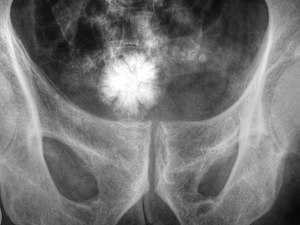
Large Stellate Urinary Bladder Stone


A stone may come out through the urethra if small in size and a plenty of water  drinking is advised.A larger stone can be removed either surgically ,laparocopically or endoscopically according to the suitability.Stone formation can be prevented by drinking as much water so that there is urine of 2 liters in 24 hours.Supplementation of vitamin A and prompt treatment of urinary infection  are important.Long term intake of calcium and steroid should be avoided .A parathyroid hyperactivity if present is to be treated.A congenital abnormality in the urinary system is to be looked at and treated.  


Reblog this post [with Zemanta]

Thursday, August 13, 2009

Urinary Tract Infection

E.coli ML30.Urine Culture Showing E.Coli a common bacteria causing  urinary infection.
    The burning sensation and severe urge for urination  is very much distressing  for of  a patients of urinary tract infection.Urinary tract stretches right from the kidneys to the urethra.Any part of it may get infected.It is mostly bacterial in origin.But may be due to TB,Sexually transmitted agents and other systemic diseases.Infection may come from local surroundings or from systemic infection.
  The proximity of urethra to the anus makes it vulnerable to contact infection from the bacterias present in faeces.It affects females more as  the urethra is short i.e. only four centimeters in comparison  to males where the length of urethra is nearly twenty centimeters.
   Once infection sets in there is fever,burning urination ,scanty frequent urination and painful urge for urination.Infection may complicate an already existing  urinary stone disease.Or may set in an anomalous urinary passage.It may also set in a disease condition causing stagnation or obstruction to urine flow i.e. enlarged prostate or stricture of urethra.

  Diagnosis is not that difficult if proper history is taken.Mainstay of investigations rest on a routine and microscopic urine  examination,a culture and sensitivity test to know the type  of infection and appropriate antibacterial agents required .Investigation like ultrasonography is done to rule out any other associated or facilitating diseases.Other blood tests to know diabetic and kidney status are also performed.
   In ladies a little prolonged antibacterial treatment is needed as compared to the males where eradication of microbe is a little bit difficult. Diseases   complicating urinary infection or as a result of it need to be treated in it own merit.    

  
Enhanced by Zemanta

Friday, June 5, 2009

URINARY TRACT INFECTION AND HONEYMOON CYSTITIS.

Urinary systemImage via Wikipedia
Dysuria,the painful micturition is very distressing and if added to it frequent urination with fever makes the patient's condition miserable.And these are hallmark of urinary tract infection.Urinary tract includes right from kidneys to to urethra.It is commonly due to bacterial infection and females predisposed to it due to proximity of urethra to the anus.E.Coli, the organism present in feces is isolated frequently now-a-days.Gonorrheal  and syphilitic infections are also seen but less than before because of rampant use of good antibiotics.Some thing called honeymoon cystitis occurs after first honeymoon in females infecting the urinary bladder. Another source of contacting infection is door handle of common toilets at community places.
Commonly urine is subjected to microscopic examination which may reveal number of pus cells and sometimes red blood cells.Culture and sensitivity of urine will give information about suitable antibiotic required.
 A little long term use of antibiotics in female is recommended  .Though it is cured without any sequel but in gonorrheal  infection complications like narrowing of urethra called stricture of urethra and other systemic complication do occur.Syphilis is more notorious for causing more dreaded complications even involve the central nervous system.


Enhanced by Zemanta

Featured Post

Cyclodextrin for Treatment of Atherosclerosis

Cardiovascular disease from atherosclerosis is one of the most common causes of death worldwide. Inflammation plays a crucial role in ...